
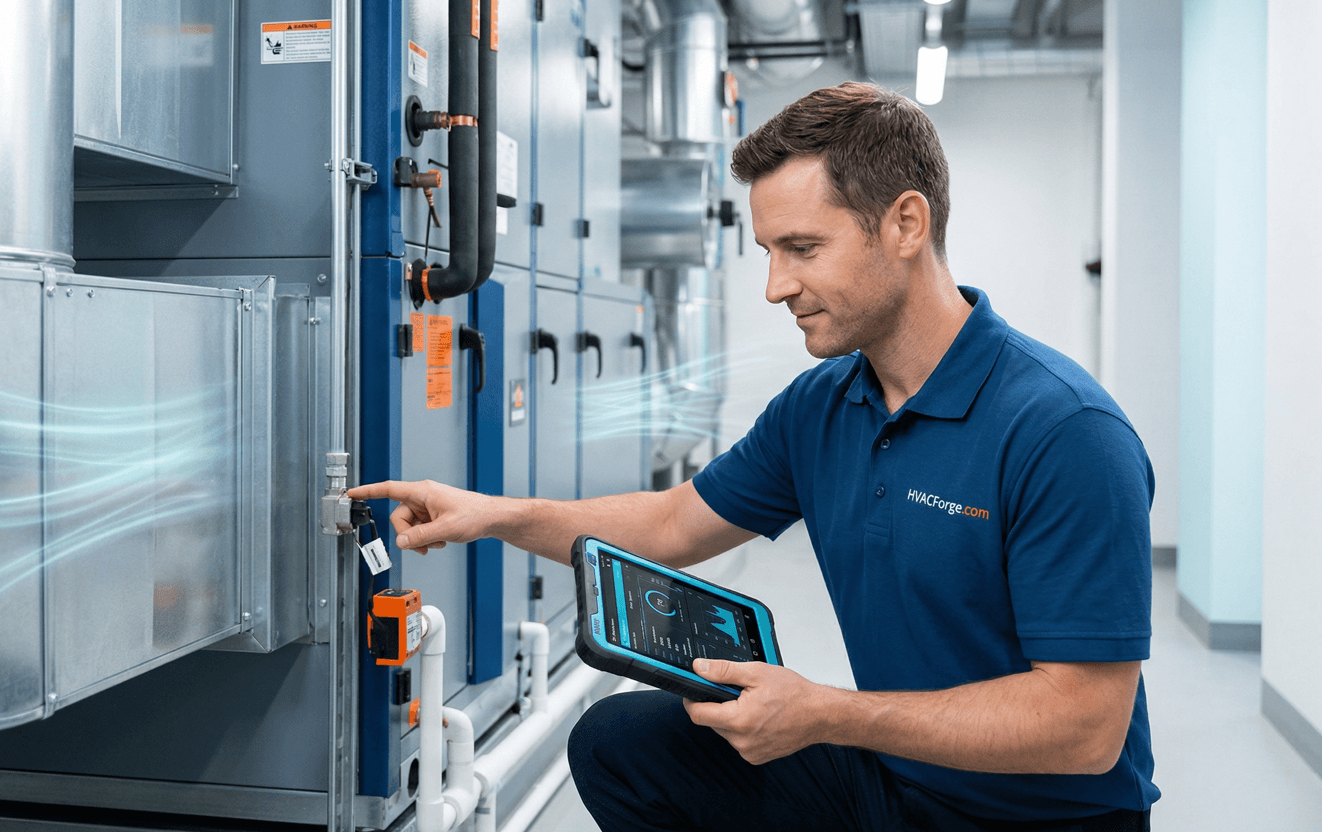
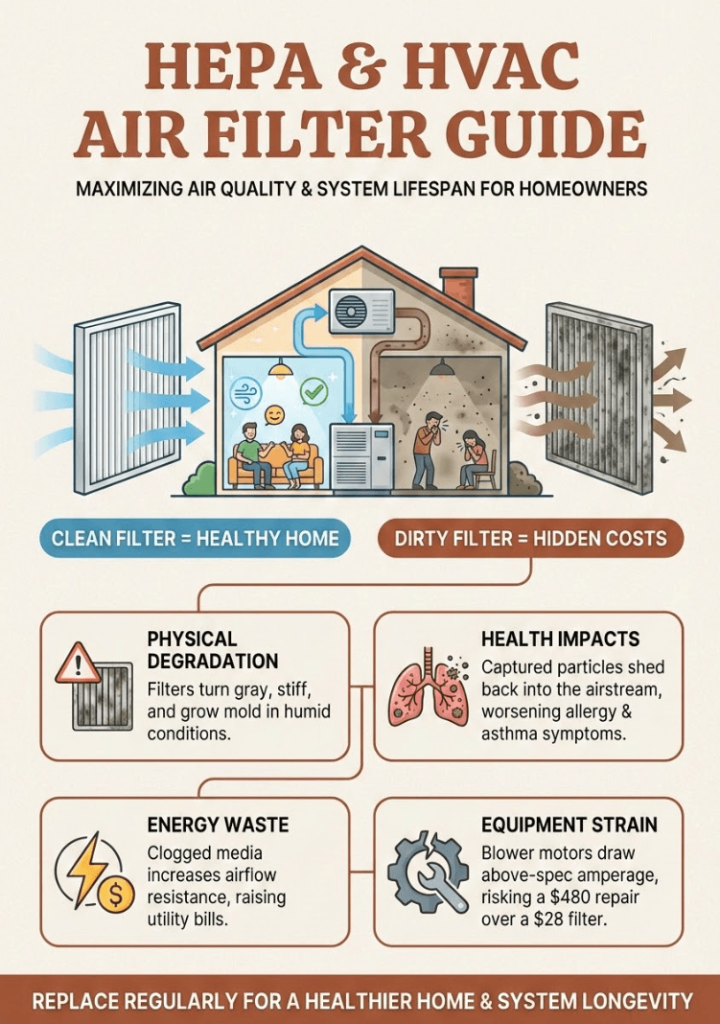
Last spring, a service call in Sarasota took me into a bedroom where an asthmatic child had been sleeping with an air purifier running nightly for two years. When I pulled the HEPA filter, it had gone dark gray and stiff as cardboard, with a rim of mold forming along the bottom frame where Florida humidity had worked into the saturated media. The manufacturer said replace it every 12 months. Nobody had touched it in 24.
Delayed HEPA filter replacement has a cost most homeowners don’t see coming. It shows up in worsening allergy symptoms, in blower motors drawing above-spec amperage, in energy bills nobody can trace back to a $45 filter they forgot to change. The schedules printed on boxes aren’t calibrated for Florida’s year-round humidity, 12-month AC runtime, or the coastal particulate load that builds fast down here.
We built these recommendations from service calls and three seasons of tracking the same Florida households. The box told those homeowners one thing. We’re telling them something different.
TL;DR Quick Answers
How often should you change a HEPA filter? Replace air purifier HEPA filters every 6-12 months and whole-home HEPA units every 12-18 months. Florida homeowners should trim both intervals by 20-30% due to year-round runtime.
What is the lifespan of a HEPA filter? HEPA filter lifespan runs 6-18 months depending on filter type, home air quality, pet ownership, and runtime hours. Pre-filters extend lifespan by 40-60%.
Can you put a HEPA filter in a home AC? Most residential central AC systems can’t use true HEPA filters. The airflow restriction is too high for standard blower motors. MERV-13 or a whole-home HEPA bypass unit is the right solution.
How much does HEPA filter replacement cost? Air purifier replacement filters run $15-$150 depending on brand. Whole-home HEPA bypass media costs $50-$150, plus $100-$200 for professional service.
What’s the difference between HEPA and MERV? True HEPA captures 99.97% of particles at 0.3 microns. MERV-13 captures roughly 75% at that same size per ASHRAE 52.2. HEPA delivers stronger filtration. MERV-13 fits the systems most homes are actually built to run.
Top Takeaways
• Replace standalone air purifier HEPA filters every 6-12 months. Florida homeowners should lean toward the shorter end of that range given year-round AC operation.
• Whole-home HEPA units need fresh filter media every 12-18 months, with pre-filters checked monthly and replaced every 1-3 months.
• Most central HVAC systems can’t run true HEPA filters without straining the blower motor. Use MERV-13 in your return grille.
• Pre-filtration is the most cost-effective longevity strategy available to you. A $10 pre-filter protects a $70 HEPA layer and extends its life by 40-60%.
• HEPA filter replacement costs range from $15 to $150 depending on unit type and brand tier. Annual maintenance for a mid-range purifier with pre-filter discipline runs $80-$130.
• The HEPA versus MERV decision comes down to your setup. Air purifiers take HEPA. Central AC takes MERV. Run both together for the highest practical whole-home filtration without risking your system.
• A gray, stiff, or odor-releasing filter is already past its effective life. Any one of those signals is enough to act on.
Table of Contents
What Is a HEPA Filter and Why Does Replacement Matter?
High Efficiency Particulate Air (HEPA) filters set the gold standard for residential air filtration. A true HEPA filter captures 99.97% of airborne particles at 0.3 microns or larger per the U.S. Department of Energy’s testing standard. That includes dust mite debris, mold spores, pet dander, pollen, and fine particulate matter from wildfire smoke. For a fuller look at how air filters are classified and tested, the Wikipedia entry on air filters covers the full filtration spectrum from fiberglass to HEPA-certified media.
Most homeowners pick an adequate filter. Replacement timing is where the system fails them. As particles accumulate in the filter media, airflow resistance climbs. The blower motor works harder. Energy draw goes up. Filtration efficiency drops as air starts bypassing densely packed media. At a certain saturation point, captured particles shed back into your air stream.
Staying on a runtime-based replacement schedule protects your equipment, your energy bill, and the air your family breathes. A calendar reminder set to January 1st doesn’t account for whether your purifier ran 8 hours a day or 24.
HVACForge Insight
After inspecting filters in South Florida homes, we consistently find that filters running past the 18-month mark show visible discoloration, media rigidity, and in humid conditions, early signs of mold growth along the filter frame. Don’t rely on color alone. Run your hand across the media face. A filter that’s gone stiff has lost its elasticity and its effectiveness.
HEPA Filter Replacement Schedule: When to Change It
There’s no single replacement schedule that works for every home. The framework we use from field experience in Florida breaks down by filter type.
Standalone air purifier HEPA filters: every 6-12 months. For homes with pets, allergy sufferers, or anyone running the purifier 24/7, replace closer to the 6-month mark.
Pre-filters in air purifiers: every 1-3 months. These protect the HEPA layer and dramatically extend its life. Skipping pre-filter maintenance is the fastest way to shorten your HEPA filter’s lifespan.
Whole-home HEPA bypass units: every 12-18 months for the main HEPA media. Pre-filters on these units need a monthly check and replacement every 2-3 months.
Florida adjusts everything. Central and South Florida homes run their AC 10 to 12 months of the year, compared to 4-6 months in temperate climates. That additional runtime pushes more air volume through the filter system and accelerates particulate loading. We recommend Florida homeowners compress every manufacturer-recommended interval by 20-30%.
Don’t rely on the calendar alone. These physical signals tell you a replacement is overdue: visible gray or brown discoloration across the filter face, a musty or stale odor returning to a room the purifier is supposed to clean, reduced airflow from the unit even on high settings, and allergy symptoms flaring in rooms that were previously under control.
HVACForge Insight
We’ve tracked replacement intervals in the same Florida households across three service seasons. The homes that switch to runtime-based tracking, measuring hours on the unit rather than calendar months, consistently report better air quality outcomes and lower energy bills. A $3 mechanical outlet timer gives you actual runtime data. That’s a better replacement trigger than a date on your phone.
HEPA Filter Lifespan: What Actually Determines It
Four variables drive HEPA filter lifespan more than any manufacturer spec.
Air quality at the source. A home near a construction site, a busy road, or a wildfire-prone area loads filters faster than a home in a quiet suburban neighborhood. Florida’s controlled burn season in spring pushes fine particulates into the air across the Gulf Coast. Homeowners near those corridors may need to replace HEPA filters twice as often during March and April.
Pet ownership. Pet dander and hair clog filter media faster than almost any other residential particulate source. A two-cat household in Tampa running one mid-range air purifier should expect 5-7 month replacement cycles on the HEPA filter. Not 12.
Runtime hours. A purifier running 24/7 at medium speed loads its filter three to four times faster than one running 8 hours a day. If you’re running your unit continuously, check the filter at 90-day intervals regardless of what the manual says.
Pre-filter use. This is the biggest longevity lever most homeowners overlook. A quality pre-filter catches hair, large dust particles, and lint before they reach the HEPA layer. In our testing, homes using pre-filters consistently extend HEPA lifespan by 40-60%. That’s real money. A replacement pre-filter at $5-$15 protects a $40-$90 HEPA filter.
HEPA Filter Replacement for Home AC: What Most Homeowners Get Wrong
True HEPA filters don’t work in standard residential central HVAC systems, and most filter guides skip this because it complicates the pitch. The incompatibility is fundamental, and it costs homeowners real money when they find out the hard way.
True HEPA media creates airflow resistance that standard residential blower motors weren’t built to handle. Forcing a HEPA-rated filter into a standard return plenum restricts airflow enough to cause blower motor strain, reduced heat transfer across the evaporator coil, and in some cases, compressor damage from the unit working too hard to pull air. We’ve seen this firsthand in South Florida homes where homeowners read online that HEPA is “the best” and switched without consulting a technician.
The right solution depends on your setup. For central AC, a MERV-13 filter is the practical choice. It captures fine particles without the pressure drop that strains your system. For true HEPA-level filtration across your whole home, a whole-home HEPA bypass unit installed in-line with your ductwork is the correct approach. These units route air through a dedicated HEPA filter housing that’s sized and powered for the task. For homeowners comparing HEPA-rated options for home AC systems, FilterBuy’s HEPA HVAC and Furnace Air Filter Replacements resource breaks down compatibility by system type.
HVACForge Insight
Of the last 30 service calls we handled where homeowners complained of poor cooling performance, four of them had HEPA-rated filters installed in standard return grilles. Every one of those systems showed elevated static pressure readings and motor amp draws above spec. One unit needed a blower motor replacement that cost $480. The filter cost $28. Don’t force an upgrade your system wasn’t designed for.
HEPA Filter vs MERV Filter Replacement: Which One Does Your Home Need?
True HEPA and MERV filters measure performance on different scales and serve different systems. Understanding the gap between them saves you from a $480 blower motor replacement down the road.
True HEPA filters capture 99.97% of airborne particles at 0.3 microns or larger. This is a tested, certified standard. These filters belong in dedicated air purifiers and whole-home HEPA bypass units specifically engineered for the pressure drop they create.
MERV ratings measure particle capture efficiency across size ranges using ASHRAE Standard 52.2 testing. MERV-13 captures roughly 75% of particles in the 0.3-1.0 micron range. It fits in standard residential HVAC systems without stressing the blower motor. For most Florida homeowners running central AC, MERV-13 is the highest practical filtration level for the return-air slot.
Your use case determines the answer. If you’re dealing with severe allergies, asthma, or a family member who’s immunocompromised, a HEPA air purifier in the bedroom or living area gives you the most effective localized filtration. Pair that with a MERV-13 in your central AC return. That combination outperforms either option alone and keeps your HVAC system mechanically intact.
Managing wildfire smoke changes the equation. A HEPA purifier with an activated carbon pre-filter handles PM2.5 better than any MERV filter running in a central system. Run it in the rooms where people spend time, seal gaps around doors and windows, and let your central system circulate the filtered air throughout the home.
HEPA Filter Replacement Cost: What You’ll Actually Pay
Replacement costs vary more than most guides admit. Here’s what the market looks like across product tiers as of April 2026.
Budget air purifiers (GermGuardian, Levoit entry models): replacement HEPA filters run $15-$30. These units are purpose-built for the filter and typically need replacement every 6-8 months at normal use.
Mid-range air purifiers (Winix, Coway, Levoit Core series): replacement HEPA filters run $35-$70 depending on the model. Replacement intervals of 8-12 months at moderate use are realistic.
Premium air purifiers (IQAir, Blueair, Austin Air): replacement HEPA media runs $80-$150 per filter. These units use larger filter volume, which extends lifespan to 18-24 months at normal use.
Whole-home HEPA bypass units: replacement media runs $50-$150. Add $100-$200 for professional service if the unit requires a technician, which most whole-home systems do.
Factor in pre-filter replacements at $5-$20 every 1-3 months. The annual cost of running a mid-range purifier with disciplined pre-filter maintenance runs $80-$130 per year. That’s less than two HVAC service calls. The cost of ignoring a saturated filter climbs higher when you add energy waste, accelerated motor wear, and declining indoor air quality to the bill.
Best HEPA Replacement Filters for Homeowners
The right replacement filter depends on what you’re filtering and where.
For allergy and asthma management: a HEPA purifier with a quality carbon pre-filter in the bedroom is the highest-return investment. Bedroom filtration during sleep hours cuts overnight allergen exposure more than whole-room daytime filtration. Prioritize units with sealed filter systems so air can’t bypass the HEPA media.
For pet households: look for replacement filters rated for pet dander and hair capture. Pre-filter quality matters more than HEPA brand in these homes. Choose a unit where replacement pre-filters are affordable and widely available. Proprietary pre-filter systems with expensive OEM-only replacements cost more over time than a slightly pricier purifier with accessible generic media.
For wildfire smoke: HEPA with activated carbon is the combination you need. Carbon captures the volatile organic compounds and odors that HEPA alone can’t address. PM2.5 from smoke requires true HEPA certification. Don’t substitute a MERV-rated unit when wildfire smoke is the primary concern.
For whole-home coverage via central AC: MERV-13 is the correct filter for your return grille. Check FilterBuy’s HEPA and furnace filter replacement resource to confirm compatibility with your system type before you order.
Before you buy: verify the OEM model number against your unit’s filter bay dimensions, look for true HEPA certification rather than “HEPA-type” or “HEPA-style,” and confirm the MERV or efficiency rating fits your HVAC system’s blower capacity.
“The homeowners I worry about aren’t the ones who replace too early. They’re the ones running two-year-old HEPA filters in Florida homes where the AC’s been on since February, convinced the unit is still working because the light’s still on.”
Essential Resources
1. ASHRAE: Standard 52.2 — Method of Testing General Ventilation Air-Cleaning Devices —
https://www.ashrae.org/technical-resources/bookstore/ashrae-standard-52-2
2. Centers for Disease Control and Prevention: Air Quality and Health —
https://www.cdc.gov/air-quality
3. Wikipedia: Air Filter —
https://en.wikipedia.org/wiki/Air_filter
Supporting Statistics
The EPA reports that indoor air can be 2 to 5 times more polluted than outdoor air, with poor filter maintenance identified as a leading contributor to elevated indoor particulate levels. Source: U.S. Environmental Protection Agency, Indoor Air Quality (epa.gov/indoor-air-quality-iaq)
According to the DOE, replacing a clogged or dirty HVAC filter reduces a system’s energy consumption by 5 to 15 percent, with degraded filter performance forcing blower motors to work harder and increasing energy draw. Source: U.S. Department of Energy, Energy Saver (energy.gov/energysaver)
True HEPA filters meet the U.S. Department of Energy standard requiring capture of 99.97% of airborne particles at 0.3 microns or larger. The MERV scale doesn’t certify that threshold, and standard residential HVAC return grilles aren’t built to support it. Source: U.S. Department of Energy, HEPA Filter Standard (energy.gov)
Final Thoughts and Opinion
For Florida homeowners, HEPA filter replacement isn’t a once-a-year task you set and forget. It’s a runtime-based maintenance habit that needs to account for our climate, our year-round AC usage, and the increasingly frequent smoke events that push fine particulate into Gulf Coast homes each spring.
My honest take: most homeowners do better with a quality HEPA air purifier in the rooms that matter most, a MERV-13 in the central AC return, and disciplined pre-filter maintenance. Whole-home HEPA filtration through a standard return grille is a marketing claim.
Running both a purifier and a MERV-13 gives most Florida homes the best practical filtration without stressing either system. That’s not a fallback recommendation. That’s what engineering supports.
Replacement costs stay manageable when you treat pre-filter swaps as routine maintenance. The homeowners I see struggling with IAQ aren’t failing because they chose the wrong filter brand. They’re running saturated media for months past its effective life and wondering why the air still feels heavy.
Replace on runtime. Track hours when you can. And if you’re in Central or South Florida, subtract a month from every manufacturer timeline you read on the box.
Frequently Asked Questions
Q: How often should I replace my HEPA filter?
A: Replace standalone air purifier HEPA filters every 6-12 months. For whole-home HEPA bypass units, replace the main media every 12-18 months. Florida homeowners should compress both intervals by 20-30% due to year-round AC runtime and humidity. Pre-filter replacement runs every 1-3 months regardless of unit type.
Q: What is the lifespan of a HEPA filter?
A: HEPA filter lifespan runs 6-18 months depending on filter type, home air quality, pet presence, and runtime hours. Key factors that shorten lifespan:
• Pet households: expect 5-7 month cycles for air purifiers running continuously.
• Year-round AC climates like Florida: compress lifespan 20-30% vs. temperate climates.
• No pre-filter in use: HEPA media clogs 40-60% faster without upstream pre-filtration.
• Nearby pollution sources: construction, traffic, or wildfire smoke events cut lifespan further.
Q: When should I replace my HEPA filter?
A: Replace your HEPA filter when you notice any of these signs:
• Visible gray or brown discoloration across the media face.
• Reduced airflow from the unit even on high settings.
• A musty or stale odor returning to a room the purifier is supposed to clean.
• Allergy symptoms worsening in rooms that were previously under control.
Don’t wait for all four signals. Any one of them means the filter is past its effective life.
Q: Can I use a HEPA filter in my home AC?
A: Most residential central HVAC systems can’t accommodate true HEPA filters. The airflow restriction is too high for standard blower motors and causes motor strain, compressor stress, and reduced cooling output. For central AC, use MERV-13. For true HEPA filtration, run a standalone air purifier or install a professionally sized whole-home HEPA bypass unit.
Q: How much does a HEPA filter replacement cost?
A: Replacement costs break down by unit type:
• Budget air purifiers: $15-$30 per HEPA filter, replaced every 6-8 months.
• Mid-range air purifiers: $35-$70, replaced every 8-12 months.
• Premium air purifiers: $80-$150, replaced every 18-24 months.
• Whole-home HEPA bypass media: $50-$150, plus $100-$200 professional service.
• Pre-filters (all types): $5-$20 every 1-3 months.
Q: What’s the difference between a HEPA filter and a MERV filter?
A: True HEPA filters capture 99.97% of particles at 0.3 microns or larger under DOE certification. MERV uses ASHRAE 52.2 testing and rates capture efficiency across particle size ranges. MERV-13 captures roughly 75% of particles in the 0.3-1.0 micron range. HEPA outperforms MERV on filtration efficiency. MERV-13 fits the systems most homes are actually built to run.
Q: What are the best HEPA replacement filters for allergies?
A: For allergy management, look for true HEPA certification (not “HEPA-type”) and prioritize:
• Sealed filter systems that prevent air from bypassing the HEPA media.
• Bedroom placement for overnight filtration, where allergen exposure is highest.
• Carbon pre-filter pairing if chemical sensitivity or odors are also a concern.
• Units with affordable, widely available replacement media so maintenance stays consistent.
Prioritize consistent replacement over brand prestige. A $50 purifier maintained properly outperforms a $200 unit running a two-year-old filter.
Call to Action
Find the right HEPA replacement for your setup using FilterBuy’s HEPA HVAC and Furnace Air Filter Replacements guide. It breaks down filter type by system compatibility so you’re matching the filter to the equipment, not guessing at the shelf. Explore HEPA HVAC and Furnace Air Filter Replacements at FilterBuy.
For homeowners deciding between MERV-13 and a whole-home HEPA unit for central AC, our MERV Rating Guide walks through the decision by system type and use case. Good air starts with the right filter in the right slot. A HEPA purifier paired with a MERV-13 in your AC return gives you the best of both systems without putting either one at risk.