
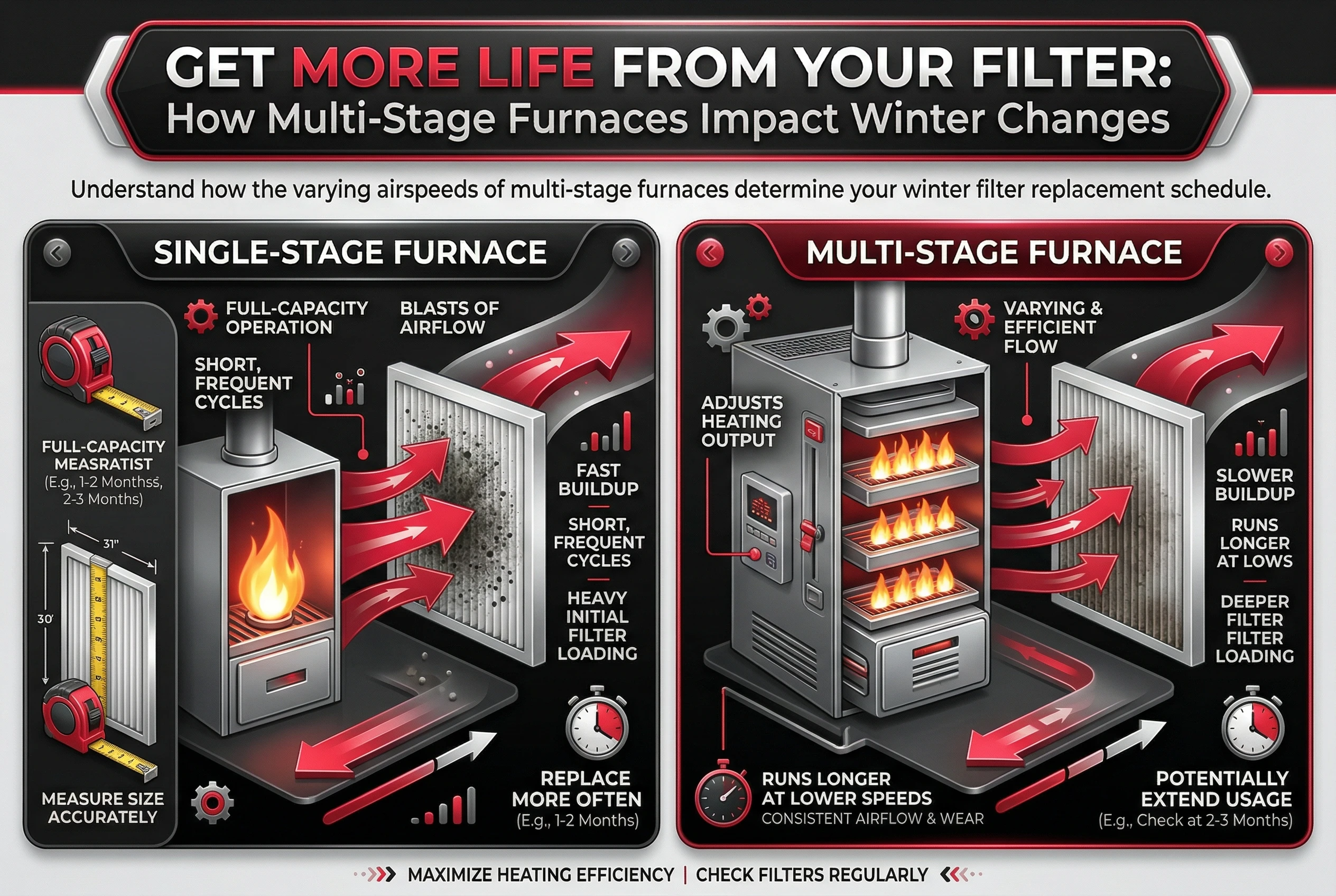
Filter life follows blower hours, not the calendar. That one rule changes how a multi-stage furnace owner should think about every winter swap, and most homeowners we meet on a service call have never heard it spelled out. A customer phoned us last January, three weeks into ownership of a brand new variable-speed furnace, certain his 1-inch pleated filter was defective because it already looked like charcoal. The filter was fine. His new furnace was running roughly twice as many hours per day as the single-stage unit it replaced, and the media was doing its job at double speed.
Nobody had told him that at the install. Modern multi-stage and variable-speed equipment moves air differently from older single-stage gear, and that difference shows up in your filter long before it shows up in your bills. If you’re still trusting the 90-day reminder printed on the filter packaging, you’re running loaded media for weeks before you swap it. We’ll fix that here, with numbers pulled from real winter service work and broken out by furnace stage.
TL;DR Quick Answers
Furnace filter replacement frequency winter
Winter filter swaps depend on what kind of furnace you own, not on the 90-day label printed on the box. From our field work in Central Florida and beyond, here’s the breakdown we give homeowners:
- Single-stage furnace: every 60 to 90 days (1-inch pleated, MERV 8 to 11)
- Two-stage furnace: every 45 to 60 days (1-inch pleated, MERV 8 to 13)
- Variable-speed or modulating furnace: every 30 to 45 days (1-inch pleated, MERV 11 to 13)
- 4-inch or 5-inch media cabinet: 6 to 9 months, with monthly visual checks during heavy use
- Pets, allergies, or wildfire smoke: shorten the interval, never lengthen it
Simple rule: filter life follows blower hours, not the calendar. The longer your furnace runs, the faster the media loads, regardless of what month it is.
Top Takeaways
- Multi-stage furnaces run longer than single-stage units, so filters load faster even though the air feels cleaner.
- Variable-speed owners should plan winter filter swaps every 30 to 45 days, not every 90.
- MERV 11 to 13 works on most multi-stage systems if static pressure stays in spec.
- A 4-inch or 5-inch media cabinet is the smartest upgrade path for high-runtime homes.
- The calendar reminder on the filter box is a starting point. Your blower runtime is the real signal.
- Pets, allergies, and dusty winter air all push the schedule shorter, never longer.
Table of Contents
The Three Furnace Stages, in Plain English
Furnaces fall into three buckets. A single-stage furnace is on or off, full burn or no burn. A two-stage unit has a high fire and a low fire, and it spends most of its day on low. A variable-speed or modulating furnace fine-tunes the burn across dozens of output levels and pairs that with an ECM blower that runs at gentle, near-constant speeds.
From a comfort standpoint, the upgrade pays off in quieter operation, steadier room temperatures, and tighter humidity control. From a filtration standpoint, the trade-off stays invisible until you pull the filter.
Why Stage Equals Filter Load
Filters don’t care about days. They care about cubic feet of air. A single-stage furnace in Central Florida might run 4 to 6 hours total on a cold January day. A modulating furnace in the same house, with the same thermostat setting, can easily run 14 to 18 hours because it’s holding temperature with low, continuous output instead of short, hard blasts.
More hours mean more air, and more air means more particles trapped in the same square inch of media. The simple rule we give homeowners is this. Roughly double the runtime equals roughly half the filter life, all else equal.
New Replacement Cadence by Furnace Stage
- Single-stage, 1-inch pleated, MERV 8 to 11: 60 to 90 days in winter
- Two-stage, 1-inch pleated, MERV 8 to 13: 45 to 60 days in winter
- Variable-speed or modulating, 1-inch pleated, MERV 11 to 13: 30 to 45 days in winter, sooner with pets
- Any stage with a 4-inch or 5-inch media cabinet: 6 to 9 months, but still inspect monthly during heavy-use stretches
Yes, that contradicts the 90-day label printed on most filter packaging. Those labels assume an average single-stage household. If you’ve upgraded your equipment, you’ve outgrown the average.
MERV, Static Pressure, and What Your Blower Can Handle
A higher MERV rating catches smaller particles. It also creates more resistance to airflow, which shows up as static pressure in your duct system. Variable-speed blowers can compensate for higher pressure up to a point because the ECM motor ramps itself up. Single-stage PSC blowers can’t, so they just move less air, your coil gets colder, and efficiency drops.
Practical bands we use in the field: MERV 8 to 11 for single-stage furnaces, and MERV 11 to 13 for two-stage and variable-speed if the duct design allows it. If you want serious filtration on a high-runtime system, the right answer isn’t a tighter 1-inch filter. It’s a 4-inch or 5-inch media cabinet, which gives you more surface area, lower pressure drop, and longer service intervals. For a deeper background on how filtration media actually works, the Wikipedia entry on air filters is a solid primer.
How to Tell Your Furnace Stage Without the Manual
- Listen at the supply registers. A modulating unit sounds like a soft, steady whisper that almost never shuts off, while a single-stage unit comes on hard and goes quiet a few minutes later.
- Check the thermostat. Multi-stage thermostats usually expose settings labeled “stage 1,” “stage 2,” or “variable” in the installer menu.
- Read the cabinet nameplate. Look for “two-stage,” “modulating,” or “ECM blower” on the sticker.
“After eleven winters servicing variable-speed furnaces across Central Florida, I’ve stopped letting customers trust the 90-day filter label. The ones who switch to a 35-day swap save their ECM blowers and breathe cleaner air, every time.”
7 Essential Resources for Smarter Winter Filter Decisions
These are the seven sources we point homeowners to when they want to verify what we’re telling them about furnace filters and winter performance. Every one is a .gov or .org publication. No product pitches, no SEO blog spam.
1. Pick the right MERV rating for your system
The EPA’s plain-English explainer of how MERV ratings actually work, with guidance on choosing the highest-rated filter your system fan and slot can accommodate.
Source: epa.gov/indoor-air-quality-iaq/what-merv-rating
2. Build a complete home filtration plan
The EPA’s full consumer guide to portable air cleaners and HVAC filtration, covering how to layer protection beyond the furnace return.
Source: epa.gov/indoor-air-quality-iaq/guide-air-cleaners-home
3. Understand why heating dominates your energy bill
DOE’s overview of why heating is the largest single energy expense in the typical home, and what proper maintenance does to that number.
Source: energy.gov/energysaver/home-heating-systems
4. See how filter installation affects blower wear
The DOE’s Building Science Education page explaining how a clogged or poorly placed filter increases furnace run time and accelerates motor wear, which is exactly the failure mode we see on neglected multi-stage systems.
Source: bsesc.energy.gov/energy-basics/hvac-proper-installation-filters
5. Know the seasonal maintenance baseline
ENERGY STAR’s heating-season checklist, including the recommendation to check your furnace filter every month during heavy-use winter months.
Source: energystar.gov/products/save-heating-costs-energy-star-season
6. Connect filter habits to indoor air quality
EPA’s foundational document on residential indoor air quality, with the data on how indoor pollutant levels stack up against outdoor air.
Source: epa.gov/indoor-air-quality-iaq/inside-story-guide-indoor-air-quality
7. Get the patient-side health perspective
The ALA’s clean-air hub, which translates filtration and ventilation into respiratory health terms anyone in your household can understand.
Source: lung.org/clean-air/indoor-air
Supporting Statistics
Three numbers we lean on every time a homeowner asks why we’re recommending a shorter filter cycle for a multi-stage system. Each one comes straight from a U.S. government or national health organization, not a manufacturer marketing deck.
1. Heating eats roughly 29% of your annual utility bill
- That’s the largest single chunk of household energy use, which means the blower behind your filter runs harder and longer in winter than at any other time of year.
- In our service work, we see filters loaded twice as fast in January as in October on the same house, with the same MERV rating, because of that runtime spike.
Source: energy.gov/energysaver/home-heating-systems
2. Indoor air can carry 2 to 5 times the pollutant load of outdoor air
- EPA studies have measured indoor levels of some pollutants at 2 to 5 times outdoor concentrations, and occasionally more than 100 times.
- We notice this most in tightly built Florida homes during cold snaps, when windows stay shut and the only thing scrubbing that recirculated air is your furnace filter.
Source: epa.gov/indoor-air-quality-iaq/inside-story-guide-indoor-air-quality
3. ENERGY STAR says check your filter every month in heavy-use season
- ENERGY STAR’s official guidance is to check the furnace filter monthly during winter and replace it at minimum every three months.
- On the variable-speed and two-stage systems we service, that monthly check almost always turns into a monthly swap, because the filter is genuinely loaded by week four.
Source: energystar.gov/products/save-heating-costs-energy-star-season
Final Thoughts and Opinion
Most of the HVAC industry still tells homeowners to swap filters every 90 days. That advice was built around a single-stage furnace running short, hard cycles, and it hasn’t caught up to what’s actually sitting in modern utility closets. If you’ve upgraded to a two-stage or variable-speed furnace in the last decade, you bought a system that runs longer on purpose. Steadier temperatures and tighter humidity control are the whole point. The price of admission is a filter schedule that respects how much air the blower is actually moving.
We won’t pretend shorter intervals are free. You’ll buy more filters per year. But you’ll also protect a multi-thousand-dollar ECM blower from running against a loaded filter, keep your indoor air cleaner during the months when you’re stuck inside breathing it, and avoid the energy penalty that comes with a clogged return path. That trade is worth it every time.
If you remember nothing else from this article, remember this. Stop counting days and start counting hours. Pull the filter once a month from November through March, hold it up to a light, and let what you see decide. Your furnace will tell you the schedule if you’re willing to look.
Frequently Asked Questions
Q: Do variable-speed furnaces actually need filter changes more often than single-stage units?
- Yes, and it isn’t close.
- Variable-speed blowers run nearly continuously in cold weather.
- Single-stage blowers fire off in short, intense cycles.
- More runtime equals more air through the filter, which means faster loading.
- Field cadence: variable-speed homes hit capacity at 30 to 45 days, single-stage at 60 to 90.
Q: Can I use a MERV 13 filter on a two-stage furnace without hurting airflow?
- Usually yes, with two caveats.
- Your duct system has to be sized correctly.
- You have to actually change the filter on schedule.
- A clean MERV 13 in a properly designed system is fine.
- A loaded MERV 13 chokes the return and spikes static pressure past blower spec.
- If unsure, have a tech measure static pressure with a fresh filter installed.
Q: Should I switch to a 4-inch filter cabinet if I just installed a modulating furnace?
- It’s the upgrade we recommend most often for high-runtime systems.
- Roughly four times the surface area of a 1-inch pleated.
- Lower pressure drop at the same MERV rating.
- Better filtration with less blower strain.
- Replacement intervals jump from weeks to months.
- The cabinet install isn’t trivial, but it pays back fast on a modulating unit.
Q: Does running the fan on “circulate” change my filter replacement frequency?
- Yes, and the effect is significant.
- Circulate mode runs the blower even when the furnace isn’t actively heating.
- That adds hours of air through the filter and shortens its life.
- If you run circulate all winter, treat your filter like one in a variable-speed system and check every 30 days.
Q: Is HEPA filtration safe for residential furnace returns?
- Almost never. True HEPA is too restrictive for residential furnace blowers.
- HEPA media is designed for sealed systems with dedicated fans, not standard return ducts.
- For HEPA-level filtration, run a standalone HEPA air purifier in your main living space.
- Stick with MERV 11 to 13 in the furnace itself.
Q: How do I know if my filter is loaded before the calendar says to change it?
- Pull it and look. Don’t trust the phone reminder.
- Hold it up to a bright light. If you can’t see light through the pleats, it’s done.
- Check for an even grey layer across the intake side.
- Feel for stiffness in the media, which signals heavy loading.
- Trust what you see, not the date you wrote down.
CTA
Ready to get the right filter on the right schedule for your furnace? Start with Filterbuy’s Winter Furnace Filter Guide (filterbuy.com/resources/winter/pre-winter-hvac-prep/winter-furnace-filter-guide-replace-this-before-temperatures-drop) for sizing, MERV selection, and ordering. Once you know your stage, build a 30, 45, or 60 day reminder into your phone and ditch the 90-day default for good.
Got a multi-stage system and you’re not sure what schedule fits your home? Drop us a note. We’ll walk you through it the same way we walk our service customers through it, with no upsell.